











One of the joys of summer is eating freshly picked sweet corn. The crisp kernels usually need no more than a sprinkling of salt and pepper or perhaps a pat of butter. Corn, whose true name is maize, is actually a grain, although some people erroneously consider it a vegetable.
Not all corn is yellow. Some types are white or a mixture of white and yellow kernels. Blue corn, grown in the Southwest and Mexico, is used mainly for chips, cornmeal and flour. Popcorn, a sizable crop, is used for only one thing.
Selecting
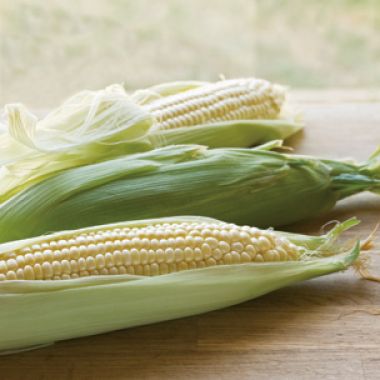
Corn is at its best when just picked, with the freshest ears usually found at farmers’ markets. Choose ears with green husks and no signs of browning or drying. They should feel cool, never noticeably warm. The silk, or tassels, should be pale yellow and moist. The kernels should be tightly packed in even rows and look plump and juicy.
If shopping in a supermarket, buy corn only if it is displayed in a refrigerated section. The ears may be partially husked and wrapped in plastic, revealing the kernels.
When you tear back the husk to view the corn in the market, you are shortening its shelf life. Once the husk is removed, the corn begins to lose moisture and freshness more quickly.
Storing
Keep fresh sweet corn wrapped in its husks in the refrigerator until you are ready to cook it, preferably for no longer than a day. The natural sugar begins to turn to starch the minute the ear is picked, so consume corn as soon as possible, although this time-honored admonishment is not as true as it once was. Growers have developed new supersweet and sugar-enhanced varieties that make longer storage possible. Hence, some fresh in-season corn will keep for more than a day.
Preparing
Strip the husks and silk from the ears, snapping the leaves off the bottom along with any remaining stem (unless you want to keep it as a handle for eating). To remove stubbornly clinging strands of corn silk, scrub the corn with a vegetable brush under cold running water.
You can drop fresh corn into boiling water and cook it quickly, roast it in the oven or grill it on a barbecue, usually brushed first with oil or butter and wrapped in foil. Four or five ears may be cooked in the microwave. The kernels can be cut from the cob and sautéed, steamed, boiled or added to a variety of dishes.
Adapted from Williams-Sonoma Kitchen Companion (Time-Life Books, 2000).